.png)
Worth Fighting For Report: Open The Books. Fund Our Services
Under Premier Ford, the Province set up new billion-dollar “black boxes” obscuring the role of for-profit administrators in public funding for social services.
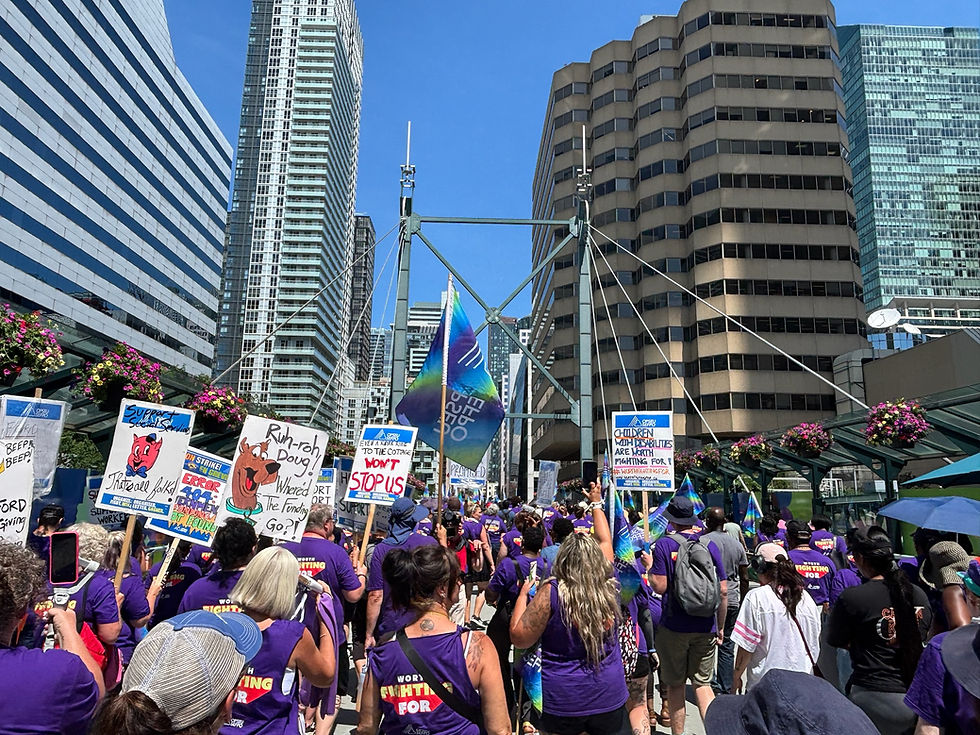
Across the province, roughly 4,000 workers are now on strike or locked out. Community and social service workers represented by OPSEU/SEFPO have taken to the picket lines in their fight for urgent and necessary investments into the province’s social safety net.
Workers in our communities providing care and support to our loved ones are sleeping in their cars, taking multiple jobs, and sacrificing too much to make ends meet. The public services they deliver are in jeopardy due to chronic underfunding and understaffing.
As a result, soaring waitlists and service delays for the most vulnerable people in our communities have become the norm.
The decision to underfund these sectors lies with the province. Even the one-time cash injections and sub-inflation funding increases simply aren’t reaching the front lines. The waitlists are growing, and the take-home pay of front-line workers continues to shrink.
“Where does the money go?” has become a frequent refrain as the Ford government avoids public disclosures and blocks access to information. Just last year, the province refused to disclose how the $2.5 billion committed to Skills Development Funds for job training was distributed and used. Investigations into the Greenbelt scandal have been plagued by an unprecedented clampdown on public access to government information.
This report examines another, as-yet unreported example of the same pattern – the ballooning use of private, for-profit companies as intermediaries between provincial funds and frontline social services.
By inserting these companies, the Province under Premier Ford has severed our ability to follow taxpayers’ money, reducing transparency and public accountability. We don’t know how much money stays with the companies, but we do know that not nearly enough “trickles down” to the front lines.
This report will map out how we got here – and why it matters. We ask why three private, for-profit intermediaries (Accerta, Serco and WCG) administered over $1 billion of our tax dollars in 2024-2025 alone. In the absence of transparent public accounting, how can we be sure that the public receives value for our money?
Given Ford’s history of decision-making that benefits private corporations, party donors and friends, the introduction of yet another set of “black boxes” raises a red flag. This report calls for sustained, adequate funding to front-line community, health and social services; public reporting on waitlists for key services; and full public disclosure of financial arrangements with private companies administering services.
Funding for key social service programs has declined during Ford’s administration
Contrary to Ford administration claims of “record funding” for the social services sector, funding has actually dropped by 2.4 percent in the latest provincial budget, once you take into account inflation and population growth.
This budget cut comes on the heels of warnings issued by the Province’s financial watchdog – the Financial Accountability Office – which found twice (in 2024 and 2025) that current service levels cannot be maintained without a serious infusion of public funding for the Ministry of Children, Community and Social Services (MCCSS).1 Taking into account inflation and population growth, Provincial funding for community services as a whole, as well as for several key social programs, has been in decline since Premier Ford took office in 2018.
Figure 1: Inflation-adjusted per capita program spending on social services during Ford’s tenure Source: Venai Raniga, CUPE

Table 1: Changes in inflation-adjusted per capita spending on key programs during Ford’s tenure. Source: Ontario Public Accounts, Statistics Canada.

As funding for community and social services plummeted over the eight-year period, waitlists for critical services grew drastically:
About 67,509 children in Ontario are on the waitlist for core clinical services delivered by the Ontario Autism Program, with most waiting more than 5 years according to a December 2025 report by the Ontario Autism Coalition.2
Over 52,000 people with developmental disabilities are currently waiting for support services in Ontario. Right now, there are more people on the waitlist than people currently receiving services.3
As of 2025, an estimated 28,000 Ontarians were on the waitlist for 18,000 supportive living units.4
The waitlist for intensive mental health care for youth and children grew to 105 days in 2025 from 94 days the year before, according to Ontario’s Auditor General.5 Kids in crisis are waiting longer and longer.
Other key social services are under pressure as needs for services grow:
The province closed 26 youth detention centres in 2021 but only opened five in the intervening years, leaving the remaining facilities overcrowded, particularly in Ontario’s North.6
While shelter funding for survivors of gender-based violence was increased, additional funding for social and legal support was left out.7
The crisis also impacts individuals receiving care as the recruitment and retention of talent becomes more challenging. The presence of known, experienced professionals familiar with the medical and care history of the individuals they support leads to better experiences and outcomes. But as real incomes for staff continue to decline, it becomes harder to both attract and retain the staff the sector depends upon.
Less transparency, deteriorating services
Even measuring the breadth and depth of the problem has become challenging. The province does not publish recruitment and retention rates for staff, unlike tracking for nursing professions in the health care sector.
Nor do we have adequate information about service levels. The waitlist figures cited here have been compiled by community advocates through Freedom of Information requests, as the provincial government has stopped publishing them.
But hiding the problem doesn’t make it go away.
Payments to the three largest for-profit administrators exceeded $1 billion in 2024-20258
As waitlists grow, Ontario’s Public Accounts document how funds sent to the for-profit administrators of key provincial social service programs have skyrocketed during recent years. This money appears not to be reaching the front lines, and the province has not disclosed how much of this money goes to pay administrators, making it impossible
to evaluate their effectiveness and value or hold them accountable. This is particularly concerning given that the Ford administration has reduced public access to information, retroactively, through Bill 97, in April 2026.9
Payments sent to Accerta, a for-profit claims administrator involved in Ontario Works, Ontario Disability Support Program (ODSP) and the Ontario Autism Program, among others, increased 232 per cent during Ford’s tenure: from $202.5 million in 2018-2019 to $672 million in 2023-2024.
Payments sent to WCG, a for-profit employment services administrator owned by an Australian company backed by US Private equity, increased 525 per cent, from $36 million in 2021 to $225 million in 2025.
The funds handled by the top three private for-profit administrators of social services alone (WCG, Serco, Accerta affiliates) reached $1 billion in 2024-2025
Who are the three biggest for-profit administrators and what do they do?
Accerta group – multiple programs
An Ontario private, for-profit government program administrator that got its start administering social assistance benefits, Accerta’s role in government-funded social programs has broadened and deepened. It describes itself as a “GovTech contractor,” administering health, government loans, portal development and reports administering public funds on behalf of 27+ government programs.10 For example, Accerta affiliates coordinate certain benefits for ODSP, Children’s Aid and OW recipients, supply provider-side coordination for the Canadian Dental Care plan, and lead the consortium running the Ontario Autism Program (OAP).11
Over the last decade, public accounts records show Ontario sent a total of $2.89 billion to Accerta affiliates. Only a fraction of this spending can be traced to programs with an open, public tender through public records. Research by End The Wait Ontario
suggests the fees collected by for-profit administrators could be substantial. They report an Accerta-led consortium is paid an estimated ~$57.9 million a year for intake services for the Ontario Autism Program (payments to individual consortium members were not further disclosed or broken down).12
At the Federal level, Accerta is represented by two lobby firms with Conservative connections, Capital Group and S&A Strategies, registered to lobby on the National Autism Strategy, suggesting possible federal expansion plans.13
WCG – Employment Services Transformation; Veterans’ Benefits
WCG began as a small for-profit HR consulting company in BC and was acquired by Australian human resources and government services multinational company APM Group in 2018.14 APM in turn was bought by Madison Dearborn, a Chicago-based private equity company focused on leveraged buyouts, in 2024.15
The McGuinty Liberal government contracted WCG to deliver employment services during a pilot running from April 1, 2005, to May 31, 2007, in six sites – Windsor, Peel, Ottawa, Hamilton, Durham region, and Nipissing. The pilot evaluation report issued in 2008 noted that the $7.6 million performance fee paid to WCG was not justified, given the poor performance. The government did not continue with WCG as the pilot did not produce the expected results.16
When Ontario privatized the administration of Ontario Employment Services under Premier Ford beginning in 2020 (including employment services for Ontario Works and ODSP recipients), WCG nevertheless won bids to administer funds in Ontario’s most populous regions – Peel, Toronto, Ottawa and York. Last year WCG received $225 million in public funds alone.17
WCG has also partnered with a Loblaws affiliate to deliver services to veterans through a $573 million contract with the Federal government. This program has come under scrutiny after clients alleged they were receiving inadequate care and “drowning in bureaucracy.”18
Before it was acquired by Madison Dearborn, WCG’s parent reported in public filings that “the majority of APM’s business is funded through various government funding programs and is dependent on the continuation and/or structure of those programs”.19
Serco – Employment Services Transformation; Drive Test
Serco is a British multinational company operating in the sectors of defence and space, justice and prisons, health care, transportation and logistics, and customer service.
Like WCG, Serco administers Employment Ontario programs, handling funds for the Northwest region and Kitchener/Waterloo/Barrie. Serco also operates Ontario’s DriveTest driver examination at over 100 locations in the province.20
Like WCG, Serco’s track record administering public services is not without controversy. In 2014 Serco paid back to the UK government GBP 68.5 million that it had overcharged the government for providing electronic tagging devices for prisoners and asylum seekers.21 Serco was also fined GBP 19.2 million in 2019 for the same fraudulent billing. In his judgment, Mr. Justice Davis said: “SGL (Serco Geografix Ltd) engaged in quite deliberate fraud against the Ministry of Justice in relation to the provision of services vital to the criminal justice system.” In 2013 Serco was accused of covering up sexual abuse at an immigration removal centre in England.22 It was also criticized for paying extremely low wages to immigrant detainees at the same facility.23
2025 reports by the Maytree Foundation and Community Living Ontario document concerns that the employment service programs administered by organizations like WCG and Serco are leaving clients with complex needs – notably, clients receiving support through ODSP and OW – behind.
To be clear, this report does not allege these for-profit administrators have not delivered value, have overcharged or otherwise engaged in wrongdoing. It does assert that we need to know much more. Transparency over financial arrangements, company track records and performance indicators are necessary for a robust public discussion over how tax dollars are spent – and an honest assessment of how well we are taking care of our community members who need it most. This transparency is the responsibility of our provincial government.
What is at stake when government spending records are hidden?
Last year, the Skills Development Fund (SDF) became a case study in how, under the cover of public policy reform, public money for public services can be steered towards private, for-profit entities – in the case of the SDF, often associated with politically connected insiders. Reporting and investigations found that wealthy Ford allies, government insiders, and party donors secured hundreds of millions of dollars for weak or hastily assembled projects, often despite internal evaluations raising serious red flags. It is difficult to view those decisions in isolation from the wider network of influence surrounding the Premier’s Office (e.g., former senior Ford staffer Amin Massoudi who ended up lobbying on behalf of a low-scoring project that received SDF funds).24
Ontario’s Auditor General concluded that the selection of wasteful and low-quality Skills Development Fund projects was “not fair, transparent or accountable,” and emphasized the lack of value for money delivered to taxpayers.25 This is not merely a finding of poor judgment; it shows a recurring breakdown in public accountability. But investigations after the fact are a poor substitute for a system designed to ensure transparency before billions of dollars change hands.
The Ford administration could have responded to these revelations by restoring transparency over spending decisions and making government records easier to obtain. Instead, the provincial government passed measures that make it even harder for the public and journalists to access information through Freedom of Information requests, and harder to follow the documentary trail when official business is conducted through Google cloud services or private cell phones. The result is a system with less visibility, fewer accessible records, and more opportunities for public money to move beyond meaningful scrutiny. In this context, opacity is not an accident. It is intentional – and it comes at enormous human cost.
Ontario has a rich history of democratic transparency, a history that is being eroded and rewritten under Ford’s Conservative government. Our public budgeting process allowed journalists, watchdogs and concerned citizens alike to monitor the flow of our tax dollars into ministries, sectors, and our services.
Under Ford, ministries are being rearranged, sectors are reshuffled, and public money flows through private intermediaries long before it ever arrives at the agencies or frontline workers providing our services.
Ontarians fought for a strong Freedom of Information Act to ensure our right to know how important public decisions are made is respected. The gutting of the Freedom of Information Act under Premier Ford’s direction and the constant legal battles to protect this government from the public finding out how their decisions are made send strong signals that this government is trying to hide how it conducts its business.
What is the human cost of public dollars being spent in secrecy?
During the time that companies like Accerta, WCG and others became responsible for billions in public dollars, we know life for people with complex needs and hardship has only gotten worse. The outgoing Ontario Ombudsman, Paul Dubé’s final report found that Ontario’s systemic failure to provide adequate community-based housing and support for adults with complex developmental disabilities has resulted in many individuals languishing in hospitals for years, experiencing deterioration in life skills and behaviours.26
The report also explicitly cites that the government, particularly MCCSS and the Ministry of Health have failed to effectively share information, engage in system planning, or build pathways for community transition—conduct deemed “unreasonable and wrong” under the Ombudsman Act.
Beyond the findings of Ontario’s highest independent officer, community agencies across the province have repeatedly sounded the alarm about the growing crisis in our communities. While the Ford government has attempted to place blame on these agencies, it is ultimately the government that is responsible for adequately funding services under its own transfer payment agreements.
The real cost of the government’s lack of transparency and accountability is borne by our communities and loved ones, a trend that will only deepen as the government continues to curb public access to information.
Recommendations
Front-line OPSEU/SEFPO members are asking for increased funding to the frontlines and wages that allow them to stay in the profession and continue caring for the people who depend on them. The estimated cost of lifting wages out of precarity across the sector is about $80 million a year moving forward, after retroactive shortfalls are addressed.
That is less than 0.4% of the Ministry of Children, Community and Social Services’ (MCCSS’s) 2024–2025 budget—and just 9.2% of what the government sent to for-profit administrators in the same period.
An immediate repayment of approximately $380 million dollars is overdue to make up for wages stolen under Bill 124. These figures to rectify years of underfunding amount to just a fraction of the funding going to for-profit administrators.
To stabilize public services and restore public confidence, the Province must deliver:
Funding: Provide adequate funding to resolve the current collective bargaining dispute with OPSEU/SEFPO-represented front-line social service workers, consistent with the modest cost estimates that have been publicly identified.
Financial disclosures: Publicly disclose the full financial arrangements with all for-profit administrators of provincially funded social services, including administrative fees, profit margins, and performance outcomes, in a manner consistent with the public interest in accountability for public funds.
Public reporting: Regularly report “vital statistics” for the sector: resume the publication of waitlist data for key provincially funded social service programs, as well as recruitment, retention and turnover data for staff.
The children waiting for autism services, the adults with developmental disabilities waiting for support, the families waiting for housing, children, youth and adults facing mental health or addition issues, and the workers holding this system together cannot wait any longer. Ontarians deserve transparency, accountability, and funding that reaches care, not more secrecy around where public money goes.
Endnotes
FAO 2025 MCCSS spending plan review, https://fao-on.org/en/report/estimates-2025-mccss/; FAO 2024 MCCSS spending plan review, https://fao-on.org/en/report/fa2305-mccss/; CCPA 2026 Ontario Budget analysis: https://www.policyalternatives.ca/news-research/the-2026-ontario-budget-neglects-core-provincial-responsibilities/
https://www.clmiss.ca/over-52000-people-in-ontario-with-developmental-disabilities-are-waitingtobelong/
Ontario’s Auditor General, https://www.newswire.ca/news-releases/ontario-children-and-youth-at-risk-of-not-getting-timely-access-to-community-mental-health-services-auditor-general-880346590.html
https://www.ontario.ca/page/public-accounts-ontario-past-editions
https://ccla.org/fundamental-freedoms/ontario-pushes-bill-97-into-law-dodging-legislative-scrutiny/
See https://accessoap.ca/about-us/ for more information about the OAP.
https://announcements.asx.com.au/asxpdf/20240603/pdf/06461g4f42s5px.pdf
Goss Gilroy Inc. (2008, October 10). Evaluation of the JobsNow Pilot: Final report. Prepared for the Ontario Ministry of Community and Social Services
2024-2025 Ontario Public Accounts, detailed statements
https://www.thestar.com/news/investigations/veterans-rehab-program-under-fire-as-mps-question-contractor-federal-officials-about-allegations/article_5ecf3127-7b2a-4fdf-a7b7-d8784e065d38.html
https://www.listcorp.com/asx/apm/apm-human-services-international/news/scheme-booklet-registered-with-asic-3070553.html
https://www.auditor.on.ca/en/content/annualreports/arreports/en23/AR_drivertraining_en23.pdf
https://www.bbc.com/news/uk-2544894 4, for-profit,for-profit
https://www.independent.co.uk/independentpremium/news-analysis/serco-contract-home-office-abuse-allegations-immigration-detention-a9347096.html
https://www.independent.co.uk/independentpremium/news-analysis/serco-contract-home-office-abuse-allegations-immigration-detention-a9347096.html
“Ford government skills training funding ‘not fair, transparent or accountable’: auditor general.” The Trillium, October 1, 2025. https://www.thetrillium.ca/news/politics/ford-government-skills-training-funding-not-fair-transparent-or-accountable-auditor-general-11288284
https://www.auditor.on.ca/en/content/specialreports/specialreports/en25/AR-PA_SDF-TS_en25.pdf
https://www.ombudsman.on.ca/en/our-work/investigations/lost-transition


Comments